Horse racing offers a different way into Saudi sport. Instead of following a ball through a long match, you watch a series of brief contests shaped by pace, positioning and the conditions of each race. The surrounding meeting adds its own rhythm: horses preparing, riders assembling and spectators moving between viewing areas. The headline race is important, but it is only one part of the experience.
This guide introduces the Saudi Cup context and the information a newcomer should read before interpreting a race. It takes a sporting and cultural approach, without betting tips or claims about guaranteed results. Use the Saudi horse-racing section for orientation. For a particular meeting, the official program and organizer’s current notice remain more useful than an undated photograph or a promotional description carried over from an earlier edition.
Start with the organizer and the correct venue
The Jockey Club of Saudi Arabia identifies King Abdulaziz Racecourse in Riyadh and King Khalid Racecourse in Taif within its venue and event information. These are separate locations. A general Saudi racing headline should not be used to infer which one hosts a particular meeting. Read the actual event entry, including the season and date, before making plans or describing where a race took place.
As reviewed on September 11, 2026, the Jockey Club was promoting the Saudi Cup for February 2027. That is a month-level reference here, not an invented exact race date. The source record notes the basis for the directory entry. The principle is simple: reproduce only the level of detail you can verify, and check the current event page when a more precise date or program becomes available.
A race meeting is a sequence of different tests
A meeting contains several races, each with its own conditions and participants. The most publicized contest may not resemble the others in distance, eligibility or surface. Read the race number and title before comparing performances. A fast-looking finish in one contest does not by itself tell you how the same horse would perform under a different set of conditions.
For a first visit or viewing session, concentrate on a few races rather than trying to understand everything at once. Observe how the field forms, where the pace develops and how positions change approaching the finish. Then compare that sequence with the next race. Differences become easier to recognize when you have watched a complete contest, rather than only the final moments selected for a highlights package.
Learn what the race program is telling you
A program is an organized description of the contest. Look for the race distance, surface, entry conditions and the list of horses and riders. The numbers beside a horse can identify different things depending on the presentation, so read the legend rather than assuming every number means starting position. Names may also be unfamiliar or similar; use the official spelling when taking notes or looking for later results.
Do not treat the program as a forecast. It supplies context and identification, not certainty about how the race will unfold. If abbreviations are unclear, use the organizer’s explanatory material. A few understood fields are better than a page of misunderstood statistics. The competition formats guide offers the same broader lesson: the labels and measurement system should be understood before drawing conclusions from the numbers.
Distance and surface define the task
The distance changes the balance between early speed, positioning and the effort required later in a race. A performance over one distance should not be transferred automatically to another. Surface also matters to the nature of the contest. Read the official description rather than judging from the color of a photograph, which can be affected by lighting or artistic treatment.
For a spectator, the useful question is how the field distributes its effort. Does one horse move forward early while another remains behind the leaders? When does the group begin to stretch out? You do not need to predict the winner to find those patterns interesting. Watching the whole race makes the finishing order more understandable and avoids reducing the event to a single dramatic image of the final stride.
Watch the horse and rider as a partnership
The rider’s decisions unfold within the horse’s response and the movement of the field. Positioning, available space and timing interact quickly. Notice when a horse finds a clear path and when it must wait or change direction. Those moments can shape the race, but a spectator should be careful about claiming to know every reason behind a rider’s decision from one camera angle.
A useful habit is to follow one clearly identified horse through the entire contest, then watch a replay focused on the leaders. The two perspectives may reveal different parts of the same race. Avoid treating an awkward moment as proof of poor effort or intent. The official result and any published stewards’ information provide a more appropriate record for decisions involving rules or incidents than a confident reaction to a brief clip.
Understand the result before interpreting the story
Check whether a displayed order is provisional or official. A broadcast image may show the immediate finish while the organizer’s published record reflects the completed process. Use the official result when discussing placings, and distinguish it from your impression during the live action. Where an incident has been reviewed, do not replace the published decision with speculation about what must have happened.
Then consider the race as a sequence. Did the winner lead throughout, improve position gradually or find a late opening? These descriptions add sporting context without pretending that one contest proves an unlimited future ability. A horse’s next appearance may involve different conditions and opposition. Following that continuity is part of the interest: you learn the participants through several races instead of assigning a permanent label after one finish.
The Saudi Cup is a focal point, not the whole calendar
A headline event can introduce international audiences to a wider racing environment. That does not make every local meeting an edition of the same race. Keep the event title, the meeting and the broader season separate. Our tournaments directory identifies the Saudi Cup as a distinct entry, while the racing section points readers toward the organizer’s wider calendar.
This distinction also helps with historical coverage. A memorable result from an earlier year should remain attached to that year’s field and conditions. Do not reuse an old participant list as an expectation for the next edition. Invitations, entries and the finalized field are different stages of event information. When a later field has not been confirmed, the accurate description is that it remains to be checked, not that previous participants will necessarily return.
Make room for heritage without inventing a history lesson
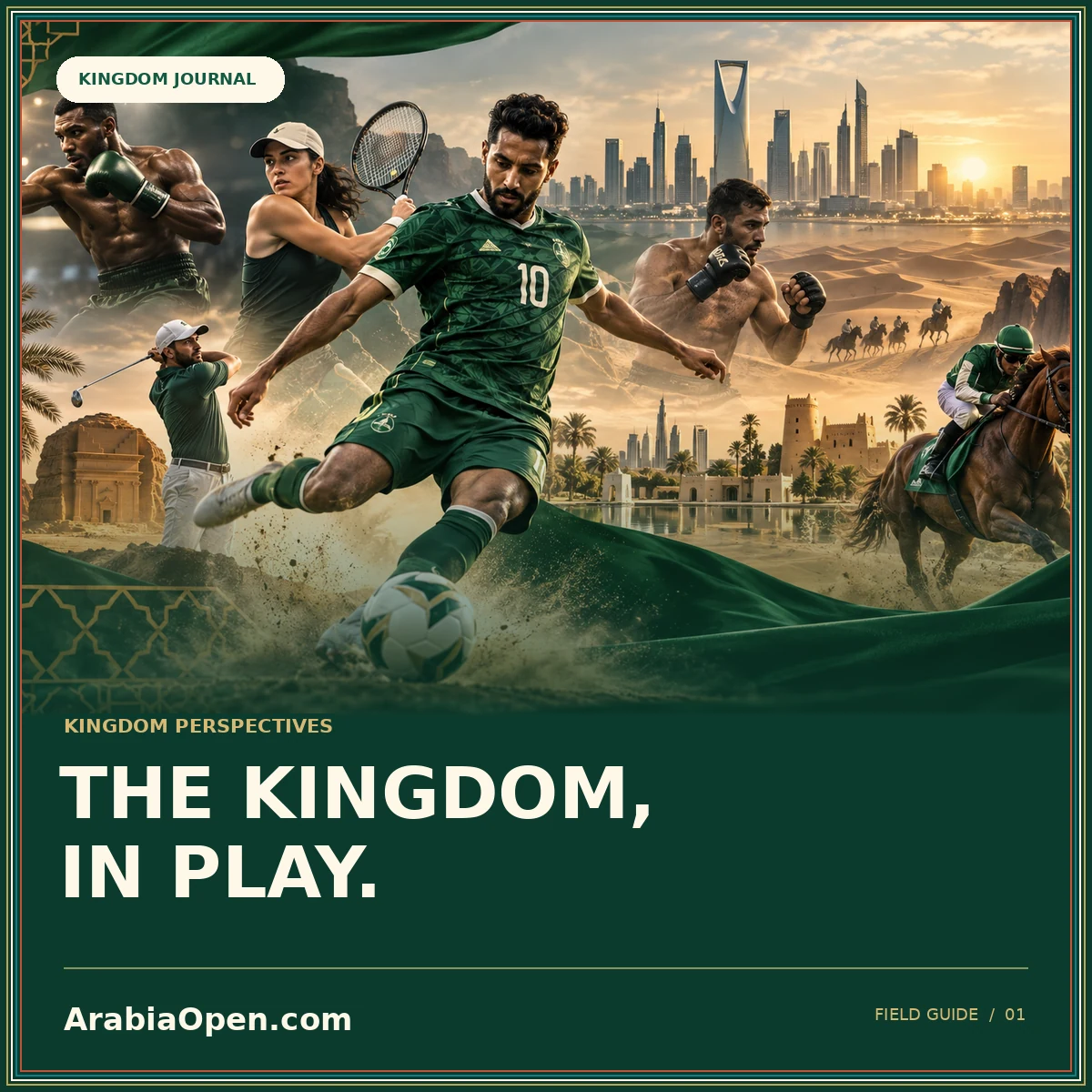
Horse racing can be explored alongside the visual and cultural setting of the event, but cultural references deserve the same care as sporting facts. A decorative motif or a dramatic desert backdrop does not document the history of a particular venue. The imagery on ArabiaOpen.com is editorial artwork, as explained in the editorial policy, and should not be used to identify real racecourse architecture or a named jockey.
At a meeting, the atmosphere can be appreciated through details such as the presentation of the horses, the movement between races and the way the program is introduced to spectators. You do not have to make sweeping claims about an entire country to describe those observations. Specificity is more respectful and more informative than treating every equestrian image as an illustration of one simplified regional story.
Prepare for the viewing experience you actually booked
Check the access conditions for your ticket or viewing area, including which parts of the venue are available. A general admission description should not be assumed to include every hospitality or parade-ring experience. Use the current organizer guidance for arrival, permitted items and accessibility arrangements. These details belong to the specific event and can change; an editorial overview should not pretend to settle them permanently.
For remote viewing, identify the authorized coverage available in your territory and whether it includes the full meeting or selected races. Highlights are useful afterward, but they may omit the preparation and field development that help a beginner learn. The event-checking guide provides a simple way to keep the venue, session, access information and latest checked date together without confusing an event listing with a booking confirmation.
Enjoy the race without needing to predict it
The sporting appeal of horse racing does not require a wager or a confident selection. Watch how the field develops, how the riders respond and how the conditions shape the contest. Read the program, identify a few participants and use the official result to complete the story. That creates a satisfying introduction on its own.
Continue with the Saudi sports overview to compare racing with the Kingdom’s other sporting connections. For the Saudi Cup specifically, return to the organizer for the current edition’s details. A clear event identity, patient observation and respect for the limits of what you can verify will make each meeting easier to follow and more rewarding to watch.